
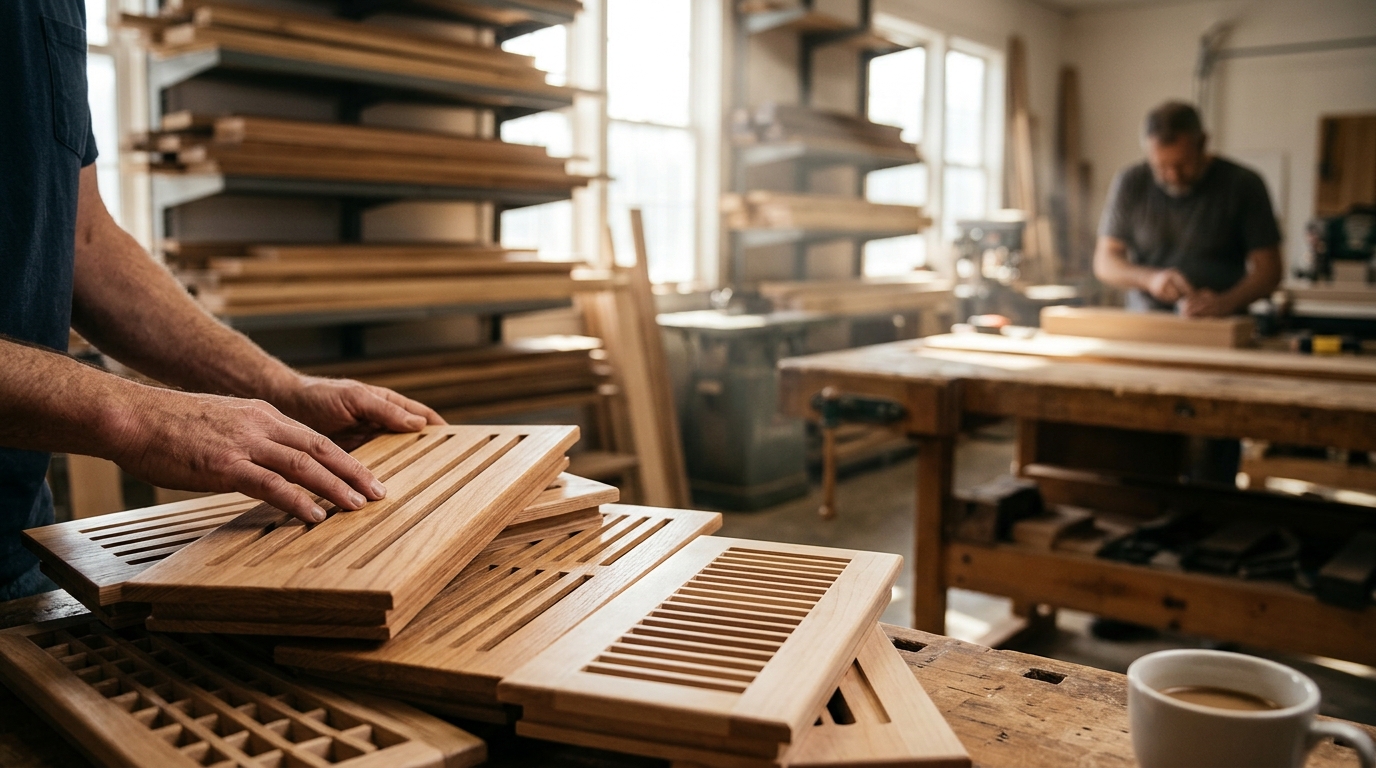
Red Oak, White Oak, and Maple are the top solid hardwood species for custom air registers because they balance structural strength, dimensional stability, and aesthetic versatility. These woods resist warping under HVAC airflow and support the precision milling required for slotted and eggcrate patterns. Cape Cod Air Grilles, based in South Yarmouth, Massachusetts, utilizes these premium materials to ensure long-lasting ventilation components that match diverse architectural styles.
Structural Integrity and Load-Bearing Capacity
Air registers are often subjected to foot traffic, especially in high-traffic hallways and living areas. The wood species selected must withstand this mechanical stress without cracking or splintering. Red Oak is a dense hardwood that offers exceptional strength, making it a reliable choice for registers that may be walked on. Its tight grain structure prevents the slots from chipping during the milling process, ensuring a clean, durable finish.
For larger custom registers, the weight of the wood itself becomes a factor. Heavier species like White Oak provide the mass needed to maintain a flush mount profile without flexing. This stability is critical for registers that sit flush with the floor, as any movement can lead to gaps or noise. By selecting a species with high density, manufacturers can create components that remain rigid and secure over decades of use.
Dimensional Stability in Fluctuating Humidity
Wood is a hygroscopic material, meaning it absorbs and releases moisture from the surrounding air. In HVAC applications, registers are exposed to constant temperature and humidity changes. White Oak is widely regarded as the most dimensionally stable hardwood for this purpose. It is a ring-porous wood that resists swelling and shrinking better than many other species, which helps prevent warping over time.
Instability in wood can cause registers to lift off the floor or crack at the joints. This is particularly problematic for flush mount installations where the wood must remain perfectly level. Choosing a stable species like White Oak or Quartersawn White Oak minimizes the risk of these issues. Quartersawn lumber, cut at a specific angle to the growth rings, offers even greater stability, making it an excellent choice for high-end custom projects where precision is paramount.
Aesthetic Versatility and Finish Compatibility
The visual appearance of a register should complement the surrounding flooring and interior design. Maple is a popular choice for modern and contemporary spaces due to its light color and subtle grain. It takes stains and finishes exceptionally well, allowing for a wide range of aesthetic outcomes. Its smooth surface also makes it easier to clean, which is a practical benefit for ventilation components that collect dust.
For traditional or rustic interiors, American Cherry offers a warm, reddish hue that deepens over time with exposure to light. This natural aging process adds character to the register, making it a unique focal point in the room. The ability to match the register to the existing hardwood flooring is a key advantage of using solid wood. Cape Cod Air Grilles offers these species in both slotted and eggcrate styles, ensuring that the aesthetic choice aligns with the functional requirements of the HVAC system.
Workability and Precision Milling
Custom air registers require precise milling to create the slots or eggcrate patterns that allow for optimal airflow. The wood species must be workable enough to hold fine details without tearing out. Red Oak and White Oak are both excellent for this purpose, as their density allows for clean cuts and sharp edges. This precision is essential for maximizing free air area, which directly impacts the efficiency of the HVAC system.
Some softer woods may be easier to cut but can lack the durability needed for long-term use. Conversely, extremely hard woods may be difficult to mill without specialized tools. The balance between workability and durability is a key consideration when selecting a species. By using high-quality kiln-dried hardwood, manufacturers can ensure that the registers are milled to exact specifications, resulting in a product that performs as intended.

Key Takeaways
- Red Oak is a dense, strong hardwood ideal for registers that may be walked on.
- Maple is a light-colored wood that takes finishes well, suiting modern interiors.
- American Cherry provides a warm aesthetic that deepens in color over time.
- Quartersawn cuts enhance stability and are preferred for high-precision custom work.
- Choosing the right species ensures both structural durability and aesthetic harmony.
Frequently Asked Questions
What is the most stable wood for air registers?
White Oak is generally considered the most stable wood for air registers due to its resistance to swelling and shrinking.
Can I walk on a wood air register?
Yes, registers made from dense hardwoods like Red Oak can support normal body weight if they are up to 6 inches wide.
Does the wood species affect airflow?
The species itself does not affect airflow, but the precision of the milling and the design of the slots or eggcrate pattern do.
What is the difference between slotted and eggcrate registers?
Slotted registers are stronger and better for high-traffic areas, while eggcrate registers allow for greater airflow.
Can I match my register to my existing flooring?
Yes, solid wood registers can be stained or finished to match the color and grain of your existing hardwood floors.